How Do You Know If Water Is Leaking Behind a Wall? 8 Signs to Check
So how do you know if your water is leaking behind the wall? You can often tell with a few simple checks, without cutting into the wall. If you see a stain, smell something musty, or get a high water bill, start here. This guide shows you what to look for and what each sign means.
Little Rock winters can bring hard freezes, and older pipes wear out over time. Both can lead to hidden leaks inside walls. Catching a leak early means less water wasted and less damage to fix.
Below, we cover 8 warning signs and the spots where shower walls leak most. You will also learn a water meter test, how plumbers find hidden leaks, and what to do next.
How Do You Know If Water Is Leaking Behind a Wall?
- Brown or yellow stains on drywall or the ceiling
- Paint that bubbles, peels, or cracks
- Soft, swollen, or warped drywall or baseboards
- A musty smell or mold near the floor
- Loose tiles or cracked grout near a shower
- A water bill that jumps for no clear reason
- A water meter that moves when all water is off
- Dripping or running sounds when nothing is on
Not sure what you're seeing? Get leak detection in Little Rock from our licensed local plumbers.
8 Signs of a Water Leak Behind a Wall
| Sign | What it looks like | How fast to act |
|---|---|---|
| Stains | Brown or yellow rings on drywall or the ceiling that grow over time | Act soon |
| Paint damage | Bubbles, peeling, or cracks in paint or wallpaper | Act soon |
| Soft or warped walls | Drywall that feels spongy, or baseboards that swell and pull away | Act now |
| Musty smell or mold | A damp odor in a closet or cabinet, or dark spots near the floor | Act now |
| Shower wall damage | Loose tiles, or grout that stays dark long after a shower | Act soon |
| High water bill | A jump in your bill with no change in how you use water | Check this week |
| Moving water meter | The meter dial moves when every tap in the house is off | Act soon |
| Running water sounds | Dripping or hissing inside the wall when nothing is on | Act now |
Water runs downhill inside a wall. A leak from a pipe higher up often shows near the floor or baseboard first. If you see a ceiling stain, check what sits above it. A bathroom or laundry room upstairs is a likely source.
Hidden water can also feed mold inside the wall, right around the leaking pipe. That is why a musty smell with no clear source needs a closer look. The longer the wall stays wet, the more drywall and framing you may need to replace.
Hard freezes in Little Rock can crack pipes that run inside outside walls. These pipes have less insulation, so they freeze first (source). A crack may not leak until the ice melts and water flows again. In the days after a freeze, check walls that face outdoors for new stains.
Spotted more than one of these signs? Our team can track down the source. Learn more about our leak detection in Little Rock.
How to Tell If Water Is Leaking Behind a Shower Wall
- The shower valve: the part behind your handle that mixes hot and cold water
- The shower arm: the pipe that runs from the wall to your shower head
- The drain: the seal where the drain meets the pipe below
- Grout and caulk: cracked lines that let splash water into the wall
Look for loose tiles, or grout that stays dark long after a shower. Check the other side of the shower wall for stains or bubbling paint. If the bathroom is upstairs, check the ceiling below it too.
To narrow down the source, test one part of the shower at a time:
- Run only the shower head for a few minutes, then check for new damp spots.
- Let everything dry. Run only the tub spout and check again.
- Leave all water off for a few hours and check one more time.
A splash leak may only need new grout or caulk. A valve or supply leak needs a plumber, since those pipes stay under pressure behind the wall.
Does the leak point to your valve or pipes? We handle shower leak repair across Little Rock. When a new cartridge won't fix it, we can replace a leaking shower valve.
How to Check for Moisture Behind a Wall Yourself
Use your water meter. Your meter usually sits in a ground-level box near the street. Turn off every faucet, appliance, and sprinkler in and around the house.
Write down the meter reading, then wait two hours without using any water. Check the meter again. If the number changed at all, the EPA says you probably have a leak.
A moving meter doesn't always mean the leak is in a wall. Toilets often leak quietly. Put a few drops of food coloring in each toilet tank and wait 10 minutes. If color shows up in the bowl, that toilet is leaking.
Press and look. Press gently on drywall near the spot you're worried about. Soft, cool, or spongy areas often hold water. Also check baseboards for swelling and caulk lines for gaps.
Use your nose. A musty smell in a closet, cabinet, or corner can point to hidden water. Open cabinet doors under sinks that share a wall with a bathroom or kitchen.
Try a moisture meter. You can buy one at many hardware stores. Test the suspect spot, then test a dry wall in another room. A much higher reading in one spot points to water inside.
Quick DIY leak check
- Turn off all water and write down your meter reading
- Recheck the meter after two hours
- Do the food coloring test on each toilet
- Press drywall and baseboards near the problem area
- Sniff closets and cabinets for a musty smell
- Compare moisture meter readings to a dry wall
How to Tell If There Is a Water Line Behind a Wall
Water lines most often run:
- Behind sinks, toilets, tubs, and showers
- Along the path to your water heater
- Behind washing machine hookups
- Behind a fridge with an ice maker
Look at the floors above and below, too. A toilet or tub upstairs often means pipes run down through the wall under it. If fixtures line up from floor to floor, pipes likely connect them.
Stud finders help, but they have limits. Many have a metal mode that can pick up copper or steel pipes. They can't detect plastic pipes like PEX. A clear scan doesn't mean the wall is empty.
A nail can cause a hidden leak. A nail through a pipe doesn't always leak right away. Sometimes the nail plugs the hole at first. Over time, the nail can rust or shift, and water starts seeping into the wall. If a stain shows up near something you recently hung, that nail could be the cause.
How Plumbers Detect Leaks Behind Walls
| Tool | What it finds |
|---|---|
| Pressure test | Whether a water line is losing pressure, which confirms a leak |
| Moisture meter | How wet the drywall or framing is at each spot |
| Thermal camera | Cooler areas on the wall where hidden water is drying |
| Acoustic listening device | The sound of water escaping a pressurized pipe |
Pressure testing can confirm a leak. A plumber shuts off the fixtures and watches a gauge on the water lines. If the pressure drops, there's a leak. Testing one line at a time shows which pipe is losing water.
Moisture meters confirm where the water is. Readings taken across the wall show where it's wettest. That wet center is often close to the leak.
Thermal cameras show temperature differences on the wall's surface. As hidden water dries, it cools the area around it. Fluke, a maker of these cameras, notes they can spot moisture behind walls under the right conditions. They read the surface, not the inside, but they point to the right area faster.
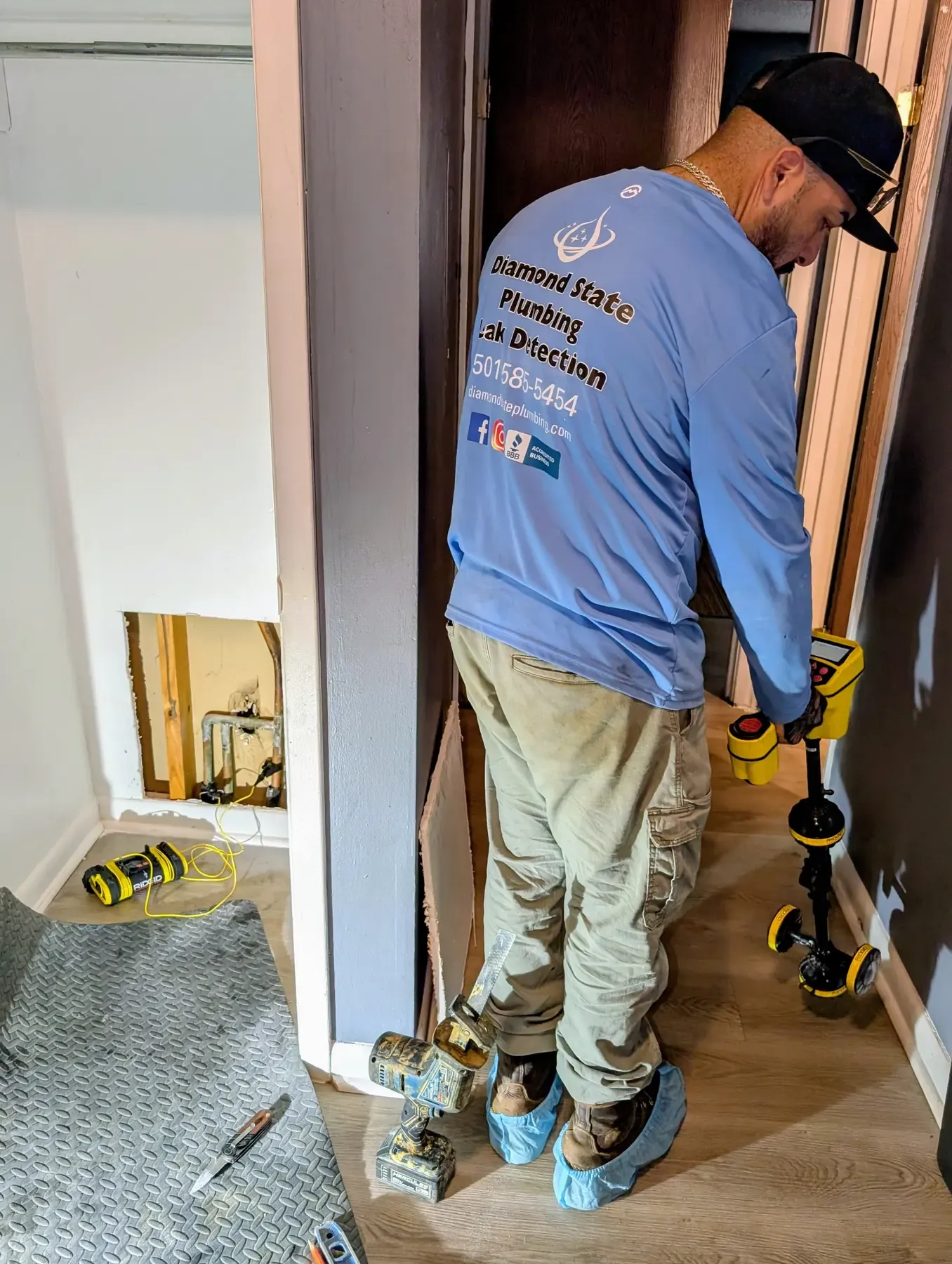
Acoustic listening devices pick up the hiss of water leaving a pipe under pressure. Our team uses this gear to hear leaks we can't see. The sound gets louder as we get closer to the source. It also helps us find leaks under slabs and in buried water lines.
Opening the wall comes last. Even with these tools, some leaks still need a small access hole. When the tools agree on a spot, the cut can stay small. That means less drywall to patch and paint afterward.
Want the leak found with less damage to your walls? Call us for leak detection in Little Rock.
What to Do If You Have a Water Leak Behind a Wall
- Shut off the water. Close the valve under the nearest sink or toilet if it feeds the leak. If you're not sure which line is leaking, shut off the main valve for the whole house. Central Arkansas Water explains where to find your shutoff valve.
- Turn off power near the wet area. Flip the breaker for any outlets or switches on that wall. Water and wiring don't mix.
- Take photos. Photograph stains, wet spots, and damaged items before you clean up. Your insurance company will likely ask for them.
- Start drying right away. Run fans and a dehumidifier, and move furniture away from the wall. The EPA says drying wet areas within 24 to 48 hours helps prevent mold (source).
- Call a licensed plumber. The leak needs to be found and fixed at the source. Drying alone won't stop it.
We work weekdays 8 to 5. If you find a leak after hours, shut off the water and call us first thing in the morning.
When we find the leak, we explain your options before any work starts. We offer financing on every job. Got another quote? Bring it to us, and we'll tell you straight if their price is already fair.
Ready to get it fixed? Our plumbers in Little Rock handle leak repair service for small drips and major damage alike. If a frozen or broken pipe caused the leak, see our burst pipe repair.
Common Questions
The shower valve behind your handle is the most common spot. Faucet maker Moen lists the valve cartridge as the most common cause of shower leaks. Drains and cracked grout or caulk can also let water into the wall.
Dry it within 24 to 48 hours to help prevent mold, according to the EPA. Use fans and a dehumidifier, and pull furniture away from the wall. Fix the leak first so the wall doesn't get wet again.
It depends on whether the leak was sudden or slow. Most policies cover sudden damage, like a burst pipe. Slow leaks that build over time often aren't covered. Call your insurer to check your policy.
Wait two hours with all water turned off, as the EPA recommends. If the meter reading changed at all, you probably have a leak. A toilet dye test helps rule out a toilet as the cause.
Yes, a hard freeze can crack pipes inside walls. Pipes in outside walls with little insulation freeze most often, according to the American Red Cross. The leak may not show until the ice melts and water flows again.
In many cases, yes. Pressure tests, moisture meters, thermal cameras, and acoustic gear narrow down the spot first. Some leaks still need a small access hole, but a focused search keeps it small.
Get In Touch
Have any questions? Contact us today for expert services in Little Rock and neighboring communities. Let us handle your plumbing needs!